
Lifetimes
The Nude Statesman
Once the playthings of a diplomatic wiz, American politics and Palestinian nationhood are now the engines of Netanyahu’s diplomatic demise
By Amotz Asa-El
HE WAS the new Abba Eban. Worldly, erudite, eloquent, and sporting an impeccable English, Benjamin Netanyahu was hardly 35 when diplomatic opportunity beckoned.
As ambassador to the UN, he would not only to become famous and build a bridge to national politics, but also ignite a statesman’s career.
Fame was established quickly, through weekly speeches to Jewish, Christian, academic and business forums across the US. The statesman’s aura was cultivated through countless television interviews where he emerged as a master of the soundbite.
And since everyone understood that the ambitious diplomat excels at explaining his country’s policy, but does not shape it, he found a way to climb to actual statecraft when he demanded that the UN hand in documents concerning its former secretary-general Kurt Waldheim’s Nazi past. Waldheim, by then the president of Austria, became an international pariah. As the Nazi went down, Netanyahu went up.
That is how at 39 Netanyahu became deputy foreign minister. It would take another eight years until he would become prime minister, but the statesman’s career was well underway.
It would be an illustrious career, one marked by high visibility, resounding speeches and remarkable achievements, only to culminate in colossal demise.
STATECRAFT came calling the morning Netanyahu became prime minister in spring 1996. The question was whether to uphold his predecessor’s Oslo Accords, which he opposed.
In a show of pragmatism, Netanyahu recognized the Palestinian Authority, met with Yasser Arafat, and even expanded the Oslo Accords, by ceding Hebron to the PA. At the same time, he prevented the emergence of a Palestinian state. Such hawkishness was disagreeable to his opponents, but it was what his voters expected, and it certainly constituted statecraft, good or bad.
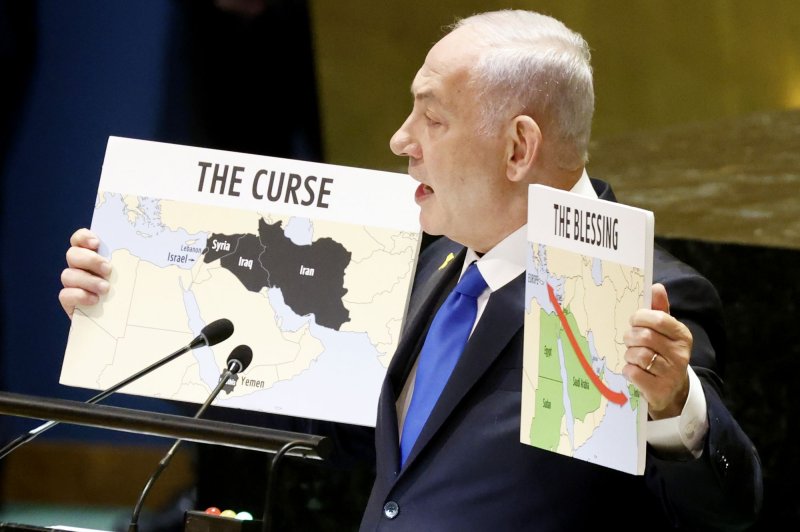
The same went for his statesmanship’s other leg – Iran. Netanyahu lost no opportunity to define Iran’s nuclear program as an existential threat, a rhetorical commitment that was coupled with lavish budgeting for a potential military showdown with Tehran.
Netanyahu’s take in both arenas created conflicting aims. Fighting Iran meant fighting Islamism, but fighting Palestinian statehood meant fighting the non-Islamist Mahmoud Abbas. The evolving statesman ignored this dissonance, and in fact resolved to exploit it, by cultivating Gaza’s Islamists as a counterweight to the West Bank’s secularists.
The consequent illusion of stability, coupled with Netanyahu’s political durability and international visibility, bolstered his diplomatic stature. By his mid-sixties, he was counted among the world’s most prominent leaders. The mature statesman hosted in his villa Indian leader Narendra Modi, convened seven African leaders for a summit in Entebbe, and attended the Red Square Victory Day parade seated alongside Vladimir Putin.
Netanyahu was now not only a famous statesman, but also one of the most veteran world leaders. When he became prime minister last century, figures like Vladimir Putin, Xi Jinping, and Immanuel Macron were still anonymous even in their own countries.
It was in that atmosphere that the ripe statesman embarked on his most diplomatically ambitious move, when he emerged in Caption Hill and from American politics’ inner sanctum attacked the leader of the free world.
Most Israelis agree with Netanyahu that Barrack Obama’s dancing with Iran’s wolves was reckless, but many doubted his provocation’s wisdom. Netanyahu’s fans silenced them. “Bibi,” they said, “knows America better than all of us. He knows what he is doing.”
Bibi’s statecraft then shone even brighter, twice. First, when he used Israel’s Mediterranean gas to create alliances with Cyprus, Greece and Italy; and then, when he delivered the Abraham Accords, which expanded Arab-Israeli peace.
The mature statesman’s confidence now flew skyward, where it would hover for several years before crashing to the ground.
FACED AGAIN with a Democratic president in Washington, Netanyahu challenged him, too.
First he ignored Joe Baiden’s call to suspend his divisive judicial reform, then he publicly attacked Baiden for slowing down arms shipments, while last year’s fighting raged.
Baiden really was tinkering with some shipments, and that sure was both unfair and unwise, but Netanyahu, as would befit the Churchillian statesman he believed he was, looked beyond the war’s demands. He was thinking about the approaching American election, and chose to gamble on Trump. That mean ingratiating Trump by squabbling loudly with Baiden.
And when Trump won, Netanyahu basked in his gamble’s success. Trump is his ally, buddy, and toy. He will sing Netanyahu’s lyrics, dance to his tune, and follow his lead. Little did he know.
THE RE-ELECTED Trump’s initial bravados – to depopulate Gaza and pulverize Iran – suggested the gamble was working. But then a different Trump came forth, and the aging statesman’s roulette spun from bingo to grief.
The Republican soulmate Netanyahu had nurtured while treating the Democrats like enemies now turned on him like a tiger on its zookeeper.
In Iran, Trump launched talks with the ayatollahs. In Yemen, he announced a ceasefire while attacks on Israel persisted. In Syria, he announced an end to sanctions against its Islamist regime. In Turkey, he set out to sell its anti-Israeli regime F-35’s, a strategic tie-breaker. In Riyadh, he is offering a nuclear reactor even without a peace deal with Israel. And in Gaza, Trump negotiated with Hamas, releasing an Israeli soldier without at all involving the declining statesman who thought Trump was his stooge.
It was, in essence, the same mistake Netanyahu made with the Palestinians, when he thought he would control them indefinitely while lying to himself that they are not what they actually are. The same went for his belief that he could control America’s leaders. Riding the tiger worked well, and even felt great, until the tiger turned its face and roared.
That, in brief, is how American politics and Palestinian nationhood, once the playthings of a diplomatic wiz, became the engines of an overripe statesman’s diplomatic demise.
The writer, a Hartman Institute fellow, is author of Ha’Sfar Ha’Yehudi Ha’Aharon (The Last Jewish Frontier, Yediot Sefarrim 2025), a sequel to Theodor Herzl’s The Old New Land
Jerusalem Post 16 May 2025