
Election '26
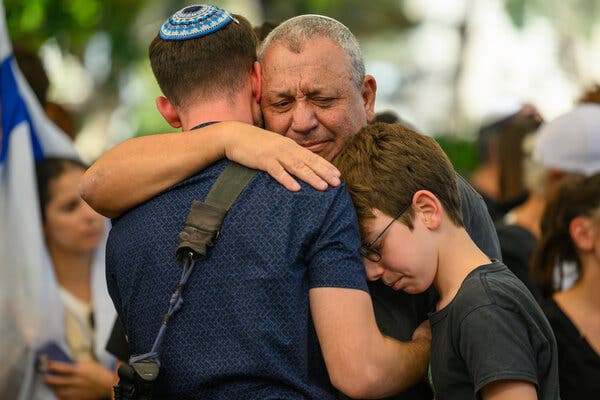
When Gadi Met Yuli
Eisenkot's zenith and Edelstein’s rebellion reflect the unraveling of Netanyahu’s political formula
By Amotz Asa-El
TALK about poetic justice.
Hardly two days after intimidating soccer’s governing body to cancel a Team USA footballer’s penalizing, the president of the United States saw his mighty superpower’s World Cup squad, along with its de-penalized player, trounced by Lilliputian Belgium 4:1.
It was a typically Trumpian tale of ignorance, absurdity, scandal and farce.
The ignorance was about soccer’s laws. “That’s not fair,” ruled the president who had just learned of soccer’s red-card rule. In itself this quip is actually reasonable. It’s what my wife said when she first saw a football tackle as the husband she had just married watched one of the NFL games which, she then realized, are part of his cultural diet. Nurit, however, didn’t follow her statement with a call to the NFL’s commissioner demanding that the rule she disliked exclude her husband’s beloved New England Patriots.
Donald Trump did call Gianni Infantino, the president of the International Association of Football Federations (FIFA), and demand that striker Folarin Balogun’s red card be canceled. That was the absurdity. The scandal was that Infantino heeded Trump’s demand, thus vindicating longstanding claims that his Qatari-funded outfit is corrupt to the bone.
Then again, this tale of poetic justice was but a comic storm in a teacup.
That cannot be said of what was happening at the same time in Israel, where two unfolding tales of poetic justice suggested that Benjamin Netanyahu’s political formula no longer works, and the social base it was designed to cement is cracking at its core.
THE stories of Gadi Eisenkot and Yuli Edelstein are very different. One was a general, the other a politician. One hailed from frozen Moscow, the other from sunbaked Eilat. One spent years as an infantry officer in Lebanon, the other as a prisoner of Zion in a Siberian jail.
The pair’s current situations are also entirely different: one is the moment’s political meteor, the other – having this week announced his departure from the Likud – is in his political twilight.
Even so, between them the two’s transitions jointly reflect the sunset of Netanyahu’s career.
Edelstein, whose three parliamentarian decades included stints as minister of health, speaker of the Knesset, and chairman of the Defense and Foreign Affairs Committee, was appalled by the draft-evasion bill that ultra-Orthodoxy’s leaders demanded, and Netanyahu vowed to pass.
In doing do, Edelstein voiced the revulsion of hundreds of thousands of Orthodox right-wingers who have borne the brunt of the fighting this country has endured since autumn ’23, leaving families fatherless and businesses shuttered for hundreds of days.
Eisenkot, at the same time, became an emblem of this ordeal’s worst part: bereavement.
The lifelong warrior’s loss in Gaza of one son and two nephews – Gal and Maor Eisenkot and Yogev Pazi – made him a potent symbol of what the serving population endured while the non-serving population’s leaders labored to etch non-service in constitutional stone.
Moreover, Eisenkot’s zenith and Edelstein’s rebellion show that Netanyahu’s loss of political altitude is about much more than the current war’s events.
EDELSTEIN and Eisenkot are representatives of two populations that were wheels of the social wagon Netanyahu rode to Israel’s helm: the so-called Moroccans and Russians.
The latter included the past 40 years’ immigrants not only from Russia, but also from the rest of the former Soviet Union and its neighbors. The former refers to the immigrations of the 50s and the 60s, which were predominantly from Morocco, but also from many other Muslim lands.
Both immigrations generally identified with Netanyahu’s hawkishness. In addition, the “Russians” liked his economic policies, and the “Moroccans” liked his rhetorical embrace of tradition (there was little of it in his private life.) In between these electorates stood the religious Zionists, who mostly hailed from veteran, Ashkenazi Israel, but were fashioned as the lynchpin of Netanyahu’s rainbow coalition of minorities.
It all worked well for him until the outbreak of this decade’s multiple wars. Now the “Russians” feel what Edelstein feels: that Netanyahu abused them. That while he had them fight war after war he had other citizens get away with serving not one day. And that while he happily collected their votes he did nothing to solve their problems, like allowing civil marriages, or easing the conversion rules that he abandoned to ultra-Orthodoxy’s devices.
That’s also what happened with the “Moroccans.”
When this electorate sees Gadi Eisenkot they see a role model, a success story of a humbly born “Moroccan” like them. When considering his tragedy – they identify with him, and fume at his detractors. And when juxtaposing his humility and sacrifice with his rival’s arrogance and conceit, a growing number of them side with Gadi, and loathe his antithesis.
The Netanyahu operation’s clumsy effort to disparage Eisenkot’s imperfect English only underscores the threat they detect. Eisenkot’s English is actually fluent – he is a graduate of the US Army War College in Carlisle, Pennsylvania. The attempt to lie about his English only shows that Netanyahu doesn’t know how to deal with this kind of “Moroccan,” one who refuses to play the role of the servile extra that Bibi has given other “Moroccans” along the years.
Looking at Netanyahu’s continuous cultivation of Shas, a machinery that deliberately prevents non-Ashkenazi Israelis’ military service and educational enlightenment, and thus sabotages the emergence of more self-made “Moroccans” like Gadi Eisenkot – many “Moroccan” voters are finally asking: what has Bibi done to us?
What has he done to you? He did to you what he did to “the Russians.” He took you for a ride. It’s been way too long, and the damage has been catastrophic, but it’s still not too late for you to finally get off his bus and hand Bibi Netanyahu the poetic justice that the career he built on your backs deserves.
Jerusalem Post 10 July 2026
PיHOTO: Gadi Eisenkot in his fallen son Gal's funeral in December 2023