
Election '26
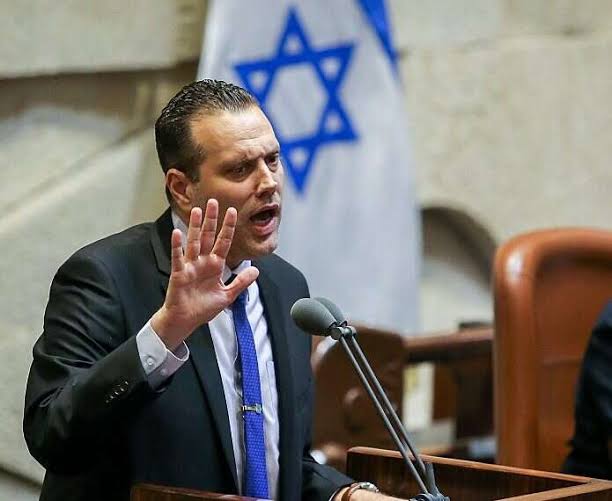
Down Memory Lane
History’s denial will cost the Likud what it cost today’s Palestinians and yesteryears’ Jews
By Amotz Asa-El
“DON'T know much about history,” songster Sam Cooke’s timeless line last century, just emerged as our culture minister’s moto, and the ruling party’s rallying cry.
The minister, one Micky Zohar (above), is not the point, The point is a statement concerning history that he made in live broadcast, and reflects the spirit of denialism that Benjamin Netanyahu and his operation are determined to foment.
Having heard Zohar tell her this week on Israel Radio that the October 7 Massacre is “possibly one of the most difficult [events] the state [of Israel] ever experienced,” interviewer Esti Perez asked in astonishment: “Do you, Micky Zohar, not think that October 7 is the most terrible event Israel saw since its establishment?”
Zohar, it now turned out, actually thinks just that. “We also had the Yom Kippur War,” he argued, “and we also had the Six Days War; these situations were not simple, and we also lost in them thousands of people.”
And after Perez explained to the new historian that in those wars the casualties were soldiers, not civilians; and after Zohar still stuck to his thesis; and after she asked angrily “why can’t you say that it’s the worst event that happened here?” – the minister of culture (of all things) lost his wits, ranted “you are dealing with nonsense!” and hung up.
If only any of this were nonsense. In fact, this is about memory, denial, and denial’s dire consequences, consequences which can be catastrophic, as we Jews should know better than all others.
THE art of denial has been practiced and perfected by many since antiquity, but two nations brought it to exceptional heights: the Jews and the Palestinians.
The Jews, in the aftermath of their failed revolts against Rome, avoided the objective study of history, as this writer showed in The Jewish March of Folly. Unlike Flavius Jospehus, a real historian who collected facts systematically and tried to interpret events impartially, the Sages who led the Jews failed to probe the strategic, military, diplomatic, and political blunders our forebears made en route to the grand defeat that the Jewish people will mourn next Thursday.
Instead, every Jew was made to confess every holiday “because of our sins we were exiled from our land.” Blame was thus shifted from reckless leaders’ political decisions to everyone else’s religious conduct. Looking at history objectively and listening to its verdict humbly, was too scary. And when shifting blame is the aim, history’s denial becomes the means.
The same thing happened in our time with ultra-Orthodox explanations of the Holocaust.
The truth, that major rabbis banned Zionism and forbade immigration to America, and thus unwittingly trapped their followers in Nazi Europe, was too scary to admit. That is what made Rabbi Menachem Eliezer Shach say “God conducted ... a long account that sprawled over centuries until it accumulated to a sum of 6 million, and that is how the Holocaust happened.” Other rabbis’ denialism produced the absurd libel that Zionist leaders wanted, and even aided, the Nazis’ extermination of ultra-Orthodox Jews (See Kimmy Caplan, Internal Popular Discourse in Israeli Haredi Society, Hebrew, Jerusalem 2007, p. 150)
The same denialism plagued the Palestinians.
No Palestinian leader, to this day, was ever prepared to publicly admit the folly of denying the Jews’ roots in this land, the recklessness of waging war on them, or the futility of rejecting the 1947 partition plan.
Yes, introspection is hard to do. Blaming everyone else except yourself is always easier, and if history, logic, justice, and morality all stand in the way – so be it.
That is exactly what is happening now with the leaders who presided over, and are out to belittle, Israel’s most catastrophic event in its 78 years.
THE facts, despite Mr. Zohar’s revisionism, are incontrovertible.
Never mind his bewildering ignorance of the Six Days War– Israel didn’t lose in that war “thousands of people”; it lost 800, as historian Michael Oren noted in Six Days of War. Much more crucially there is no comparison between wars with minimal civilian losses, as both the Six Days War and the Yom Kippur War were, and a war with massive civilian losses, as we have endured since 2023. This is of course besides the gap between the swift victory in which the Six Days War ended, and the October 7 War did not.
The quest to blur these simple facts is part of a broader concert in which Netanyahu is playing first violin. Its opening allegro was the refusal to appoint a judicial commission of inquiry, reflecting the fear of truth that was discussed here when that decision was taken (“The truth about denial,” 21 November 2025.)
It was in that spirit of denialism that Netanyahu tried to shift the blame to the army, to military intelligence, to the General Security Service, to the judiciary – anyone but himself. Zohar’s clumsy attempt to join this effort only shows he understand what his leader expects. Both men want to make us doubt that what happened is what happened, and believe that what didn’t happen happened.
Now, with election day hardly three months away, the war on truth will intensify, as the Likud’s propaganda masters set out to invent, multiply, and yelp lies like Benjamin Netanyahu’s libels and Micky Zohar’s canards.
Denialism’s cost is exorbitant. Had the Jews studied their history impartially, they would have understood centuries before Theodor Herzl that regaining their land and restoring their power is their task, not God’s. And had the Palestinians not denied the same history, they would never have been displaced, dishonored, and dismembered.
Now the political establishment that led Israel before, during, and after its most catastrophic moment is climbing the same path, the path that begins in denial and ends in eviction, dissolution, and disgrace.
Jerusalem Post 17 July 2026