
Film
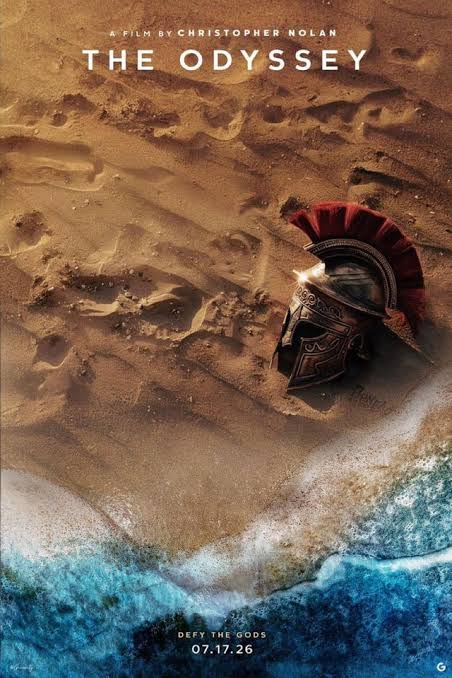
The Jewish Odyssey
The Homeric tale’s cinematic revival comes while another homecoming tale faces narrative assault
By Amotz Asa-El
SLOUCHING in a Jerusalem multiplex's deep, red chairs, the audience of Christoper Nolan’s blockbuster The Odyssey were shaken violently, as the 4D seats tried to help them feel what Odysseus and his men felt after Poseidon sparked the storm that only Odysseus survived.
This veteran film buff had never been to such a screening, and his recommendation to you is to avoid it. If a movie is bad, no external pyrotechnic will save it, and if it’s good it won’t need such non-filmic help. And Nolan’s rendition of Homer’s epic is more than just good, as its grossing of $250 million in hardly two weeks attests.
Yes, its’ anachronisms are numerous, and often glaring. Homer and his contemporaries didn’t say “civilization,” they did not call their era the Bronze Age, and they never crowned a black queen, as Nolan did by casting Lupita Nyongo as Helen of Troy, ignoring not only ancient Greece’s conditions and norms, but also the text description of Helen as “white armed.”
The debate about the film’s historical value is thus valid. Claiming that the Trojan War was about trade routes is a thought taken not from Homer, but from these days’ nightly news. And attaching to Odysseus a guilt trip over having cheated Troy with his wooden-horse trick is about as realistic as a remorseful Donald Trump losing sleep over his election-fraud lies.
Even so, the film is compelling, and that is where its significance lies. In an age when literature is elbowed daily by the soundbite, the emoji, and the tweet, Nolan’s creation will familiarize tens of millions with one of Western civilization foundational works.
For this to be achieved Nolan’s mastery of his medium, and his ability to tell an ancient story to a modern y audience, could not suffice. Homer’s own talent was equally crucial, as was the power of his narrative, a story whose energy survived the passage of some 3,000 years.
Written roughly in the days of Isaiah, this work had nothing to do with the Jews. Its narrative, however, sure is relevant to the Jews, as their own narrative comes under assault.
HOMER'S epic is powerful because it is a story of homecoming. Anyone who has ever followed a departed lover, relative, friend, or role model’s journey to the unknown will be captured by its plot.
As children raised by Holocaust survivors we begged to be told stories about “the war,” not because we had any idea what those stories really told, much less what they meant, but because we knew those travails would make be great stories.
Our hopes to debrief the survivors around us were repeatedly dashed, but we knew enough to understand that their stories contained any odyssey’s three parts: calamity, survival, victory. Decades later, while piecing together those untold stories, we realized that, like The Odyssey, they were tales of homecoming.
The homecoming tale’s combination of misfortune, struggle, and poetic justice is why millions over the centuries loved reading The Odyssey. When they read how the hero’s ship got wrecked, how he grappled with longing for his wife Penelope while in Calypso’s captivity, how he and his men were trapped by the one-eyed Cyclops, or how they navigated their ship between the multi-headed monster Scylla and the sucking whirlpool Charybdis – readers were gripped by the adventure, and drawn to read on, to the story’s rewarding end.
All these suspense, pace, and overarching destination survived the ancient poem’s latest adaptation, despite its toying with Homer’s narrative and with his era’s knowledge, lingo, and norms. And if the Homeric Odyssey's narrative survived time’s transitions – so should the Jeiwsh Odyssey's.
THE Jewish people’s story is in some ways the Odyssey’s inversion.
Yes, Jewish mythology has a cross-desert journey checkered with supernatural events, a story about a mighty giant struck in the middle of the forehead, and also a homecoming tales like Jacob’s journey to Iraq and back.
However, Judaism’s foundational story, as philosopher Michael Waltzer observed in Exodus and Revolution(1986), is not The Odyssey’s cyclical route, but the linear route of the Exodus, whose participants, rather than depart in the hope of returning to their journey’s point of origin, are sworn to never see it again.
In this story the unknown is even more ominous than in Homer’s tale, because its Israelite heroes’ encounter with their journey’s horrors is not the result of a journey from the wilderness to the homeland, but of a deliberate departure to the wilderness from the land where they were born.
Still, the Israelites’ successors, the Jews, sure would have a story about a cyclical journey’s departure from, and resolve to return, home.
THE quest to return home, which in the Homerian tale was the story of one man, is in Jewish history the story of an entire nation. And what for Odysseus lasted one decade, has been the Jewish experience for centuries. And the actual return, which in his case lasted hardly two weeks from his reemergence in Ithaca, has been the Jewish story for nearly 150 years, and may well take another 150 years until this homecoming tale finally reaches its end.
The Jewish people’s return to their point of origin, then, has the same makings of a powerful story that made The Odyssey the classic that it is. The only difference is that the Jewish story’s factuality is much clearer, and that its third part is unfolding against the world’s eyes.
Now, like the suitors who first tried to wrest Odysseus’s wife, land, and crown, and once faced with him challenged his narrative - insisting he had died and his adventures were myth – the Jewish Odyssey’s discontents are doing the same thing: what the Jews endured while abroad, the claim, never happened, and the nation they claim to be - is long dead.
Psychologically, it’s an understandable reception for an absentee assumed dead. Politically, it’s a recipe for defeat. Ask Homer.
Jerusalem Post 24 July 2026
The English edition of Amotz Asa-El's Hebrew bestseller The Jewish March of Folly is now available on Amazon