
Leadership
Into the Blue
Exhuming the Altalena’s wreck would not be about preventing civil war, but about provoking it
By Amotz Asa-El
IT started with Joseph. The expat who made it big in Egypt commanded his people “you must carry my bones up from this place.” (Genesis 50:25) The Hebrew viceroy’s will was fulfilled to the letter, albeit centuries later, when “Moses took the bones of Joseph with him because Joseph had made the Israelites swear an oath.” (Exodus 13:19)
The same thing happened with Theodor Herzl and Zeev Jabotinski, who died abroad and were reburied in the Jewish state they craved, but never saw.
These precedents came to mind this week as Benjamin Netanyahu pompously announced the “finding” of the sunken Altalena, and his determination to pull from undersea the boat that starred in a deadly clash between Menachem Begin’s militia and the IDF’s troops.
Sadly, this exhumation – an expensive and complex operation that will doubtfully happen – bears none of the spirit of reconciliation and consensus that animated Herzl and Jabotinsky’s reburials. In fact, it is their inversion.
NAMED after Jabotinsky’s pen name (Italian for seesaw), the Altalena sailed from Marseilles on June 11, 1948 carrying some 5,000 rifles, 450 machine guns and carts of ammunition. The shipment was commanded by Begin’s Irgun, in the declared hope that it will help fight the unfolding War of Independence.
It was three weeks since Israel declared its independence and the Arab armies’ invasion of the newborn state. As Begin’s biographer noted, the Irgun’s very purchase of arms violated its previous agreement to have the Hagana – now the IDF – approve any such deal in advance (Avi Shilon, Begin: 1913-1992, Am Oved 2007, p. 127).
Even so, after the ship had reached Israel’s shores a negotiation with Ben-Gurion’s representatives ensued. Begin agreed to hand the arms to the IDF, but insisted that one fifth would go to the Irgun’s units, which were still intact. Begin evidently thought, and certainly hoped, he could prolong his units’ separate existence. This, despite an agreement on June 1 that the Irgun’s men blend in the IDF.
The road from this attempt at bargaining to bloodshed was short. On the political level, Ben-Gurion presented an ultimatum, which the Irgun rejected. On the military level – shots were fired.
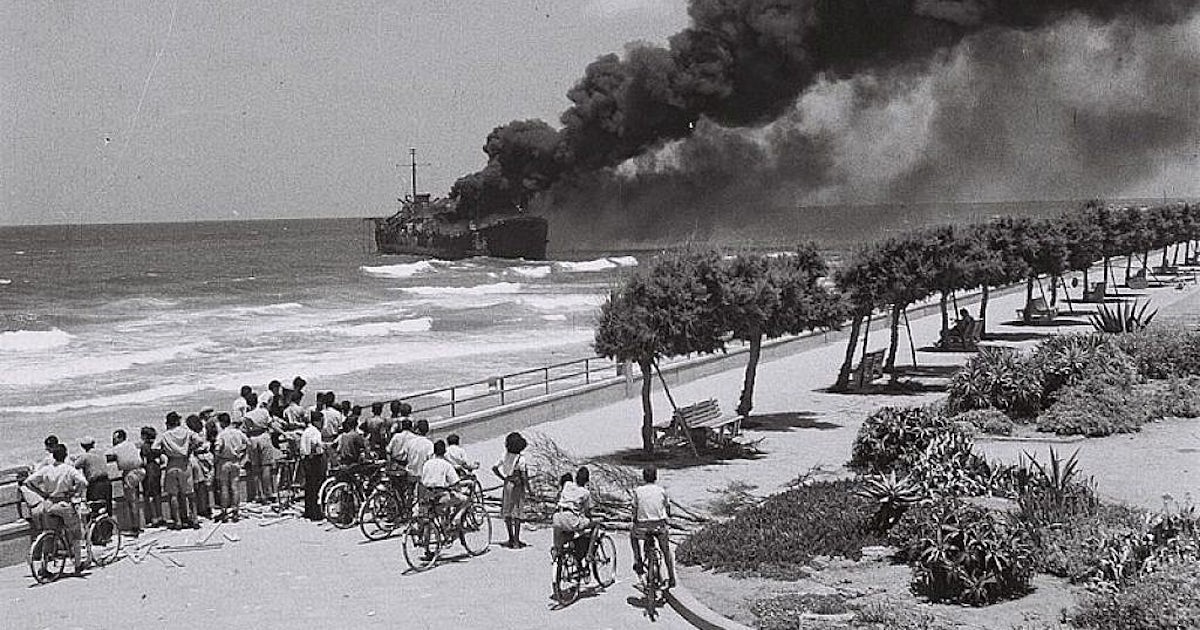
Who fired the first shots is a subject of debate to this day – all testimonies were partial. There is no argument about the location: the violence began north of Netanya, whence the vessel sailed to Tel Aviv – now with Begin himself on board. And there, opposite today’s Dan Hotel, rifle shots made way for the cannon fire that disabled the boat (above). By day’s end 19 Israelis were dead, 16 from the Irgun and 3 from the IDF.
THE Altalena showdown was turned by Begin into a big myth, a clash between a brutal Ben-Gurion and a magnanimous Begin, who – in this narrative – held his people back with the call “no to civil war,” broadcast on radio after the battle had ended.
The opposite camp, needless to say, had its own narrative. Hundreds of Begin’s followers were defecting from their IDF units and thronging to Tel Aviv’s beach, spawning suspicion of a gathering revolt. And Begin’s brave call not to fight came only after he had been knocked out.
This is besides the sequel to the clash which Begin and his people conveniently ignored, namely, Ben-Gurion’s equally resolute dismantlement of the Palmach, the Left-leaning crack units that spearheaded the IDF’s victory in the War of Independence.
Ben-Gurion understood that if Israel is to be a real state, it must monopolize violence, which meant one army with one command. To understand the alternative one need only look at Lebanon’s two armies, or to the Kurds’ multiple militias, and understand that this is no way build a nation.
THE Altalena’s wreck became a public hazard, drawing children to dive unsafely to the Mediterranean’s waves from its rusty rails. Heeding a call from Tel Aviv’s municipality, Ben-Gurion had the navy drag the ship’s remains west and dump it undersea. And that’s where the lies that animated this week’s farce begin.
The Altalena was not “found,” because its location, 20 kilometers offshore and 500 meters undersea, was well-known. Still, saying it was “found” is designed to create the impression that Benjamin Netanyahu had just discovered Atlantis.
That is besides the insinuation that the wreckage can teach us something we didn’t know, the way US president Zachary Taylor’s body was exhumed in 1991 following suspicions he was poisoned (he wasn’t), or the way the grave of John Kennedy’s assassin, Lee Harvey Oswald, was opened in 1981 to verify it actually contained him and not a Soviet spy.
Retrieving the Altalena’s decomposed skeleton would shed no light on what happened in June 1948. It would, however, be used to cultivate the myth that civil war was waged out of the blue by Ben-Gurion and prevented by Menachem Begin, who in fact had provoked it.
But to Bibi the facts are immaterial. What he cares for is the chance, no matter how slim, to change the approaching election’s subject, which is his role in Israel’s worst-ever catastrophe. That is why he emerged this week by the Altalena battle’s location, stared into a camera, and with the Mediterranean azure behind him declared: “Civil war – never!”
This sanctimony comes to us from the eye-rolling man who consciously pitted us against each other, inciting the mob against the courts, the police, and the media, sending the serving population to unending wars while exempting a multitude of his supporters from any service, and, for good measure, libeling "the Left” for having “forgotten what being Jewish is.”
Exhuming the Altalena would therefore not be about yesteryear’s civil war, but about today’s, and it would not be about unearthing history, but about fleeing its verdict – the verdict that will soon be issued by the people Netanyahu divided, and read to his ashen face between his era’s last dusk and the following morning’s dawn.
Jerusalem Post 28 August 2026