
Mideast
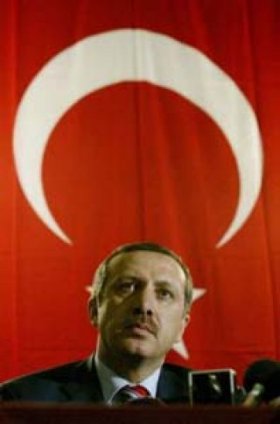
Talking Turkey
Erdogan’s effort to buy F-35's should be resisted not because of his Ottomanism, imperialism, bullyism, or antisemitism, but because he is an engine of Islamist zeal
By Amotz Asa-El
“The bomber will always get through,” said British statesman Stanley Baldwin in autumn 1932.
It was a time when many thought the fighter plane obviated the need in large ground forces. Future wars refuted that thinking, but the quality of a country’s air force remains a vehicle of its military power and political sway.
That is why Turkey’s quest to obtain the world’s best fighter jet, the American-made F-35, is a major international issue involving not only Ankara and Washington, but also Athens, Jerusalem, the Arab world and every Western country. All these have a variety of reasons to see in this deal a threat, but one reason should trump the rest.
THE Turkish army is one of the world’s largest and finest, with more than 2,200 battle tanks, some 250 fighter jets, roughly 100 combat vessels and nearly 1 million well-trained troops. A successor to the military that conquered the Ottoman Empire’s tricontinental realms, this army underpinned the modern republic that vowed to bury its Ottoman prehistory.
Turkey was thus a natural co-founder of NATO. It bordered the Soviet Union, the successor to Turkey’s historic enemy, Russia, and it shared the West’ fear of communism’s advance. And that is where the first reason to resist the F-35 deal comes in.
Yes, communism is gone, but Russia is alive and kicking. Occupying a swathe of Ukraine, Moscow treats the West as a rival and casts a shadow over its European heartland. That’s not how Turkey sees things.
Set aside its refusal to join Washington’s anti-Russian trade sanctions, in 2017 Ankara signed a $2.5 billion deal to buy Russia’s S-400 air-defense system. That’s not what you do if you want to be America’s ally. Owning these missiles while flying Uncle Sam’s best fighter jet can help the Russians improve their anti-aircraft weapons’ response to its American challenges.
Still, the F-35 deal’s American consequences dwarf compared with its meaning for Turkey’s neighbors, first of all the Greeks.
“Greece will not be pleased if the United States decide to sell the F-35 fighter jets to Turkey,” Defense Minister Nikos Dendias said this month in Athens. That’s an understatement. Turkey is Greece’s historic enemy, the one that in 1974 molested predominantly Greek Cyprus, and still occupies its north. There is constant military tension between Ankara and Athens, traditionally tempered by NATO to which they both belong. But that was before Donald Trump.
Having repeatedly called into question NATO’s right to life, Trump doubtfully understands what countries like Turkey and Greece mean to each other, or indeed for the US. As he sees things, what matters is that Turkish President Recep Erdogan “is a close friend of mine” and that “Turkey is a very strong country.”
One wonders what that “close” friendship actually is. Erdogan doesn’t play golf, drink, or womanize. How, then, did he become Trump’s buddy? Late-night sign-language conversations between a man who speaks only Turkish and another who speaks only English? Who knows?
What we do known is that a bolstered Turkish air force is a problem not only for Greece and Washington, but also for Turkey’s bigger neighbor, the Arab world.
It is now 23 years since Turkey pivoted from Kemal Ataturk’s European orientation to Erdogan’s Middle Eastern alternative. It began with a much-heralded offer of a Turkish-Arab free-trade zone. It was a seemingly harmless idea, but its main addressees – the rich Gulf states and populous Egypt – smelled a neo-Ottoman imperialism and said “no, thanks.”
And then came the so-called Arab Spring’ uprisings. Turkey provoked the Arab elites by openly backing the Islamists who tried to seize Egypt, Tunisia, and Yemen. And then Turkey invaded Syria, occupying to this day much of its north.
Arab governments, then, also don’t want to see a reinforced Turkish military brandishing a fleet of F-35’s.
Israel’s problem is in the same vein, except its fear is not about the traumas from the Ottoman past. It’s about here and now, as Turkey openly hosts, aids, and justifies Israel’s most brazen enemy, Hamas, ignoring its open demand that Israel cease to exist, and its leaders’ vows to repeat the kind of massacre they carried out on October 7, 2023.
Having turned Syria into its proxy, Turkey now effectively borders Israel while wielding a vast army and spewing antisemitic vitriol day in day out. Even so, the main reason to stem Ankara’s military growth is not its regional bullyism, but its religious zeal.
UNDER its current leadership the country that was once a paragon of secular governance has since strayed to religious reaction.
On the anecdotal side, this counterrevolution meant, among other things, lifting Ataturk’s ban on wearing headscarves in public institutions, and fighting alcohol consumption by imposing heavy sales taxes on its consumers.
On the substantive side this transition meant funding a network of more than 4,000 Islamist junior high-schools, while more than one tenth of Turkish teen-agers were tracked to Islamist high-schools that received more than twice the budgeting of regular schools. This is how the Islamist supremacism that threatens Western civilization and international harmony is incubated.
"The mosques are our barracks, the domes our helmets / The minarets our bayonets and the faithful our soldiers,” wrote Recep Erdogan before he rose to power. Such was the Islamist zeal of the man who would later call Israel “bloodsucking” while multiplying Turkey’s jailed population from 50,000 in 2002 to more than 400,000 today, most of them political prisoners, including opposition leader Ekrem Imamoğlu.
No one needs such a tyrannical Turkey: not the Arabs, not the Jews, not the Europeans, not the Americans and not the rest of mankind, not to mention the Turks themselves, even without the world’s best fighter jets, let alone with them.
Jerusalem Post 31 July 2026