
Leaders
The Regime Change That Happened
Iran’s Islamists remain alive politically, but morally, the Khomeini Revolution is dead, as the mullahs' choice of supreme leader attests
By Amotz Asa-El
THE end was swift. With Hitler dead, Germany overrun, and its army dismembered, the Third Reich’s theoretical president, Admiral Karl Donitz, ordered the military’s chief of operations, Gen. Alfred Jodl, to sign the surrender instrument that ended World War Two’s European part.
With its president-for-20-days having proceeded from this act to the Nuremberg Trial’s defendants’ box, Germany’s regime-change process was formally underway.
Now, anyone who cares for freedom hopes that this is what will happen in Iran in the aftermath of the attacks it is sustaining at this writing. Alas, chances of such a scenario unfolding in Tehran are nil.
GERMANY’S surrender followed a massive ground invasion of some 4.5 million troops who pincered it from its east and west. The current attack on Iran, by contrast, does not, and in all likelihood will not, involve a ground invasion at all.
That is why there will be no foreign occupation of Tehran that would remove its leaders and install others in their place. The ayatollahs know this, and that is what they meant to say when they picked their slain leader’s successor this week.
Their choice was an inversion of Gen Donitz: not an admiral whose sole task would be to deliver the previous order’s surrender, but a turbaned cleric whose installation is designed to announce the previous order’s defiance, audacity, and persistence.
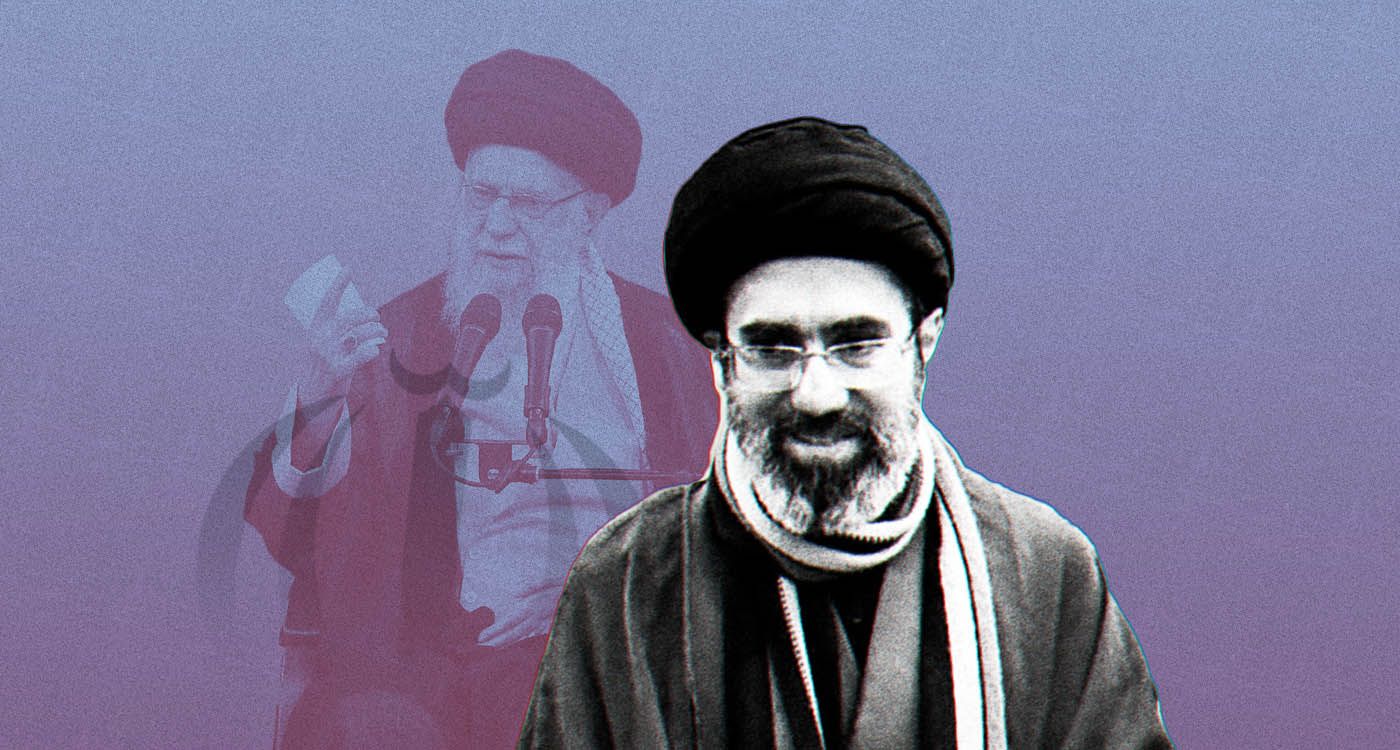
Well, despite this political survival, morally the Khomeini Revolution is dead, as the appointment of Mojtaba Khamenei (above) attests.
THE Khomeini Revolution’s most potent engine was its popular support. Yes, the mullahs never had the guts to hold a truly free and fair election that would measure, and thus challenge, their popularity. Even so, in the revolution’s early years, a critical mass of Iranians sincerely hated the shah and liked his successors.
The ayatollahs’ social strategy was transparent and efficient. The previous regime’s elite were attacked, frontally and violently, most notably with the executions of the military’s top brass and senior government officials. The moneyed elite was chased abroad. The middle class was intimidated but tolerated. The rural masses, ay the same time, were nurtured as the regime’s naturally conservative backbone.
This structure lasted for about a generation, and then began to crack. Its decline has been evident for years, as noted here already last decade (“The truth about Iran’s unrest,” 6 January 2018).
As had happened with the communist idea long before the downfall of the Soviet Union, too many Iranians had ceased to believe in the Khomeinist idea, and in the leadership that represented it. Like the declining USSR’s mandarins, the ayatollahs also choked the economy, created their own privileged elite, stifled social mobility, and destroyed the environment.
Like the USSR’s roughly 10 million Communist Party members, the roughly 100,000 members of Iran’s Revolutionary Guards controlled and bilked the economy, at the people’s expense. In Iran, this stranglehold made the people struggle with hyperinflation, eat meat hardly once a week, and watch the regime’s cronies thrive while millions of university graduates were unemployed.
Even so, the ayatollahs sent their destitute country into imperialistic adventures from Yemen to Lebanon, much like the declining USSR’s invasion of Afghanistan. It was an economic alchemy that was financially absurd, even before one considers this project’s political recklessness.
In the Soviet Union, the combination of economic stagnation, political privilege, foreign adventurism, and loss of ideological faith ultimately undid the empire, between the fall of the Berlin Wall in 1989 and the USSR’s dissolution in 1991.
However, the communist downfall was foreshadowed already in 1981, when mass protests in Poland made the army declare martial law and take over the government, thus elbowing away its communist leaders.
This regime change was a communist country’s effective vote of no confidence in the communist system, even though the coup’s leader, Gen. Wojciech Jaruzelski, nominally represented the communist system, and never publicly denounced its tenets.
Apparently, it is this kind of general that the CIA is now seeking somewhere in Iran; someone who would confront the system from within, while wielding a portion of the system’s own power.
The differences between the communist past and the Khomeinist present are obviously vast, most notably the absence of an external attack in either Poland or the USSR, as opposed to Iran’s situation right now. Still, this is what Iran’s leaders fear, and what drove their choice of Ali Khamenei’s successor, a choice that proves they have lost touch with their own revolution.
MOJTABA Khamenei's selection as his father’s successor bluntly violates the Islamist revolution, first and foremost because it ignores Ayatollah Khomeini’s express order not to appoint as supreme leader a previous supreme leader’s son. Such hereditary power, he said, would be the beginning of a monarchy, so much like the regime that the revolution so proudly replaced.
Secondly, the appointment, according to Middle East expert Ehud Yaari, also violated Ali Khamenei’s express order in his will not to appoint his son. And thirdly, Khamenei Jr. lacks the religious credentials that the title Ayatollah entails, and the role of supreme leader demands.
In other words, from the viewpoint of the revolution itself, this appointment makes a mockery of everything that the revolution was meant to represent. But the regime’s moral bankruptcy is even blunter when one considers not what its new leader’s CV lacks, but what it contains: A central role in massacring demonstrators, hounding dissidents, rigging elections, and embezzling the national chest.
In other words, the people who crowned Khamenei the Second installed as the leader of Iran a man who, besides being a religious lightweight and a political novice, is a professed enemy of the Iranian people. The Khomeinist Revolution’s journey from economic decline and political decadence through imperial megalomania to moral bankruptcy has thus reached the nadir that will ultimately be its grave.
Jerusalem Post 13 March 2026