
Trends
What After Charisma?
Israel needs an anti-charismatic leadership, like those which succeeded Ben-Gurion and Begin with surprising results
By Amotz Asa-El
Theodore Mommsen was infatuated.
Julius Caesar, wrote the future Nobel laureate in The History of Rome, was “a statesman genius,” one so “perfect” that such a figure emerged only “once in a thousand years,” like the “consummate beauty” that even the most gifted painter “can only be silent” in its face.
Written in 1856 it was the kind of partiality that historians are expected to avoid, reflecting a German nationalist’s thirst for a charismatic leader who would unite his politically splintered people. That great leader would be far wiser, bolder and more visionary than ordinary people. Charisma, the gift of natural leadership, would make that superhero deliver what no one else could achieve.
A similar attitude inspired Zionist historian Joseph Klausner’s depiction of the Messiah. “Judaism’s Ubermensch,” he wrote, would be a superhero “far greater and stronger than the multitude, a personality to which all willingly submit.” Inspired by Mommsen’s portrait of Caesar, Klausner painted Judea's King Alexander Janneus not as the despot that rabbinic memory recalled, but as “a great king … dedicated to his country’s expansion and the spread of its faith.”
Such thinking was legitimate, even common, among German-educated intellectuals for generations – until World War Two. The fascist nightmare produced a new breed of historians who realized that charisma is not necessarily a gift, and in fact can become a curse.
Writing in his acclaimed Caesar: A Biography, historian Christian Meir shrank Mommsen’s superhero into an opportunistic politician who had no coherent vision of Rome’s future, and thus did not shape the great events in which he played a central role. Instead, Caesar was now portrayed as a shrewd tactician who responded to events that were shaped by forces larger than himself.
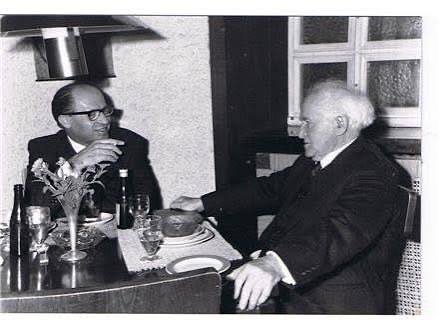
FOR Jewish graduates of the twentieth century such suspicion of charisma goes without saying, even though charisma also did us good, most memorably when David Ben-Gurion (above right) used it to win war, and when Menachem Begin (left) used it to deliver peace. Now, however, the Jewish state is in the process of shifting from an era of charisma to an era of anti-charisma.
How long this transition will last is anyone’s guess, but for an Israel crushed by an overbearing Benjamin Netanyahu’s charisma, the post-charismatic era’s emergence will arrive not one day too early.
ISRAEL has already had two post-charismatic eras, and their results were surprisingly good.
The current age of charisma began in 1996, when Netanyahu first became prime minister. Though there were other prime ministers during the subsequent decades, Netanyahu shaped the era, as discussed here on that anniversary (“Has it been 30 years?” 29 May 2026). And Netanyahu, even his rivals agree, led by charisma.
Netanyahu was more handsome, eloquent, and brash than any of his opponents. None could work a crowd, manage a press interview, phrase a political slogan, engineer a journalistic photo or deliver a televised speech more effectively than him.
In turn for all this, and as has so often happened with charisma, these merits came coupled with a soloist’s failure to consult, or even just tolerate the presence of, other able people. The charismatic leader thus gradually became not merely the government’s leader, but the government itself.
That is why people now wonder, after surveying his potential successors: how will they get into Bibi's shoes? It is the same question people asked in 1963, when David Ben-Gurion stepped down, after leading Israel’s creation, and that is what people asked in 1983, when Menachem Begin stepped down six years after unseating Ben-Gurion’s heirs.
In both cases the question was even harsher than it is now, not only because Ben-Gurion and Begin were much larger than Netanyahu, but because their successors were even less charismatic than the men who may soon replace Netanyahu at the state of Israel’s helm.
LEVI Eshkol was an unassuming, bespectacled, balding and grandfatherly man who loved to tell Yiddish jokes and looked like a tailor who had just emerged from a Lower Eastside sweatshop. Whether in his intellectual curiosity, literary diet, historical insight, political vision or rhetorical ability – he was no Ben-Gurion.
Similarly, Yitzhak Shamir was no Menachem Begin. Begin spent decades in the public limelight, delivering fiery, eloquent and unwritten speeches in mass rallies and heading the opposition for nearly 30 years. Shamir spent most of the same years in the opaque labyrinths of the Mossad. Short, stocky, bushy eyebrowed, introverted and ineloquent, he was charisma’s antithesis.
Even so, this pair of antiheroes did incredible things.
Eshkol built the army that struck the greatest military victory in Jewish history. Before that, as finance minister in the 1950s, he built the economy that was the fastest growing in the world, alongside Korea and Japan. And as prime minister, he inspired national reconciliation, first by ordering an official funeral for his party’s historic nemesis, Zeev Jabotinski; then by canceling Israel’ military rule over its Arab towns; and finally, by bringing Menachem Begin into the government that won the Six Days War.
Similarly, the uncharismatic Yitzhak Shamir led 4 million Israelis’ successful absorption of 1 million immigrants from the fallen Soviet Union. While ate it, he airlifted Ethiopian Jewry. In the interim, he managed with great poise Israel’s precarious situation during the First Gulf War. And before all that, he and his archrival, Labor’s Shimon Peres, jointly saved a hyperinflationary economy from collapse.
Shamir and Eshkol registered all these achievements not despite, but because of their lack of charisma. Their grayness only made them positively humble, focusing on the issues rather than on themselves, harnessing rather than fearing talent, and inspiring business-minded team work rather than spend their days thinking of the next photo op, soundbite or speech.
Now, as the post-Netanyahu era steadily approaches, this is what Gadi Eisenkot and Naftali Bennett offer, and what a traumatized Israel’s future demands.
Jerusalem Post 16 October 2026