
Politics
The Pious Alliance
The only way to a durable coalition is a pact between ultra-Orthodoxy and Mansour Abbas
By Amotz Asa-El
THEY'RE stuck. The coalition talks look like staircases in an Escher drawing: everything moves from everywhere to anywhere and reaches nowhere. Lieberman says take in ultra-Orthodoxy, Bennet says can’t do that, take in Likud. Golan says can’t take in Likud, take in the Arabs, but Bennet and Liberman say can’t take in the Arabs. Eisenkot says let’s do a minority government, but then all three tell him not with us.
And then come the demands of Likud’s absolute monarch, who seems unaware he lost a quarter of his voters: I am on top, I give nothing, and I bring in all my friends. The more these gentlemen talk, the harder they step on the hamster wheel’s bars. No wonder people feel we face a Rubik’s Cube that cannot be solved.
But Rubik Cubes are, by definition, solvable, and this one is no exception. One dark horse and one improbable alliance can cut the Gordian knot, reboot Israeli politics, and reinvent the Jewish state.
THE dark horse is Mansour Abbas.
The 52-year-old dentist is a product of the Galilean town Mghar, where 15,000 Druze live alongside 10,000 Christians and Muslims. Tolerance in this town, famous for its picturesque mixture of churches and mosques, is both a necessity and a tradition.
That Abbas is a new type of Arab politician became clear five years ago, when he joined the Bennet-Lapid government. A religious Muslim who used to deliver sermons in a local mosque, Abbas has said that his national identity means little to him. So does religious triumphalism. That’s very different from the secular nationalists and religious fundamentalists that have led the Palestinian movement for more than a century.
Abbas’s record is pragmatic and pluralistic. In spring 2001, after Arab rioters torched a synagogue in Lod, Abbas went there, and from within the shrine’s charred walls condemned its arsonists and vowed to personally contribute to its restoration.
Following the October 7 massacre by Hamas, Abbas minced no words condemning it, saying it was “inhuman and impossible to justify,” And called for the Israeli hostages’ immediate release. "Kidnapping women, children, and elders,” he scolded Gaza’s Islamists, “is forbidden according to Muslim values.”
Before that, when asked about Israel’s Jewish identity, he said “the state of Israel was born as a Jewish state and such it will remain.” And before that, on Holocaust Remembrance Day 2020, Abbas said from the Knesset’s podium: “Holocaust denial is a relic of the Nazi ideology, a moral failure, and a betrayal of the values of truth and justice.”
Does all this make Mansour Abbas a Zionist? It doesn’t. It does, however, set him apart from the virulently anti-Zionist rhetoric that is common among Arab politicians outside his United Arab List.
Are all the rest of his faction’s members as nice as he is? They aren’t. One, Iman Hatib Yasin, tried to deny the extent of Hamas’s atrocities on October 7, and had to backtrack and apologize after Abbas publicly rebuked her. Another, Walid Taha, once called imprisoned terrorists “prisoners of conscience.”
Such quotes are very problematic indeed. Still, these are the exceptions in Abbas’s project, which adds up to a brave effort to reprogram Israeli Arabs' political thinking, rhetoric, and conduct. Hence his recruitment of politicians like Ibrahim al-Turi, a pharmacist from Rahat whose public activity focuses on municipal affairs.
Far more unorthodox has been Abbas’s decision to take on as his Number Two a Jew, Yoav Segalovitz, a former head of Israel’s equivalent of the FBI, known as Lahav 433.
Abbas’s pragmatism thus climbed to a new peak, an effort to deliver a serious war on organized crime in Arab towns, a scourge that Segalovitz had fought effectively., first as a police commissioner, and then as the Bennet government’s deputy minister of internal security.
The United Arab List, in short, unlike the Joint List, can fit into an Israeli coalition.
However, such a coalition cannot be narrow, if it is to last. Abbas must therefore seek a way to broaden its base, and this he can do by forging an alliance with – fasten your seatbelts – ultra-Orthodox Israel.
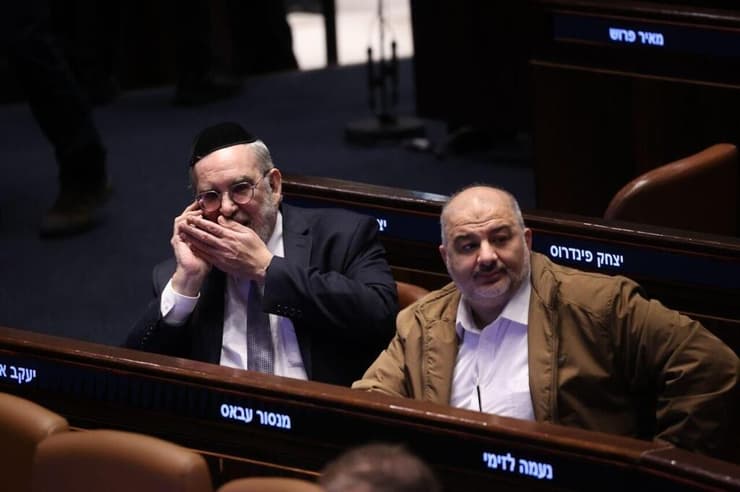
THE new alliance will be launched in a meeting between Abbas and the “Lithuanian” yeshivas’ sages, Rabbis Dov Lando and Moshe Hirsch. “We exchanged blessings and then compared our agendas,” Abbas would tell the press, sitting alongside United Torah Judaism Chairman, Yaakov Asher (above, left, next to Abbas, in the Knesset plenum).
“We concluded that our communities’ interests never collide, and often meet. We both want faith, safety, and budgets, and we will help each other secure them. And unlike the zealots who challenge both our faiths, we want peace.”
News of the alliance will first baffle all, but then it will prove to be a solid axis and a bridge to Arab-Jewish coexistence. Most importantly it will restore sanity to a political system gone mad.
Right now, as long as the man who paralyzed the political system, Benjamin Netanyahu, does not clear the stage, this alliance of the pious is the only workable formula we have. Without its 15 lawmakers there will be no durable coalition.
Middle Israelis will be divided. Some will besmirch the alliance as “the non-Zionist axis,” others will hail its potential contribution to peace. All will agree that, four years on, the struggle for universal national service must be resumed, this time with a redesigned Likud’s backing.
Until then, all will fathom the reinvention of Israeli politics by an unassuming dentist and his deployment of Israel’s most disenfranchised population, the Bedouins, of whom 80 percent voted for Abbas.
Last year, when Israel intercepted Houthi missiles in outer space, people said: who would have thought that the first Star Wars would be fought between the Yemenis and the Jews. Next year people will say: who would have thought Israeli politics would be rebooted by Lithuanians and Bedouins.
Jerusalem Post 27 November 2026